

When Systems Work Perfectly Wrong: How POSIWID Reveals What School Really Taught You
The uncomfortable truth about education that changes everything you thought about learning, your children, and yourself

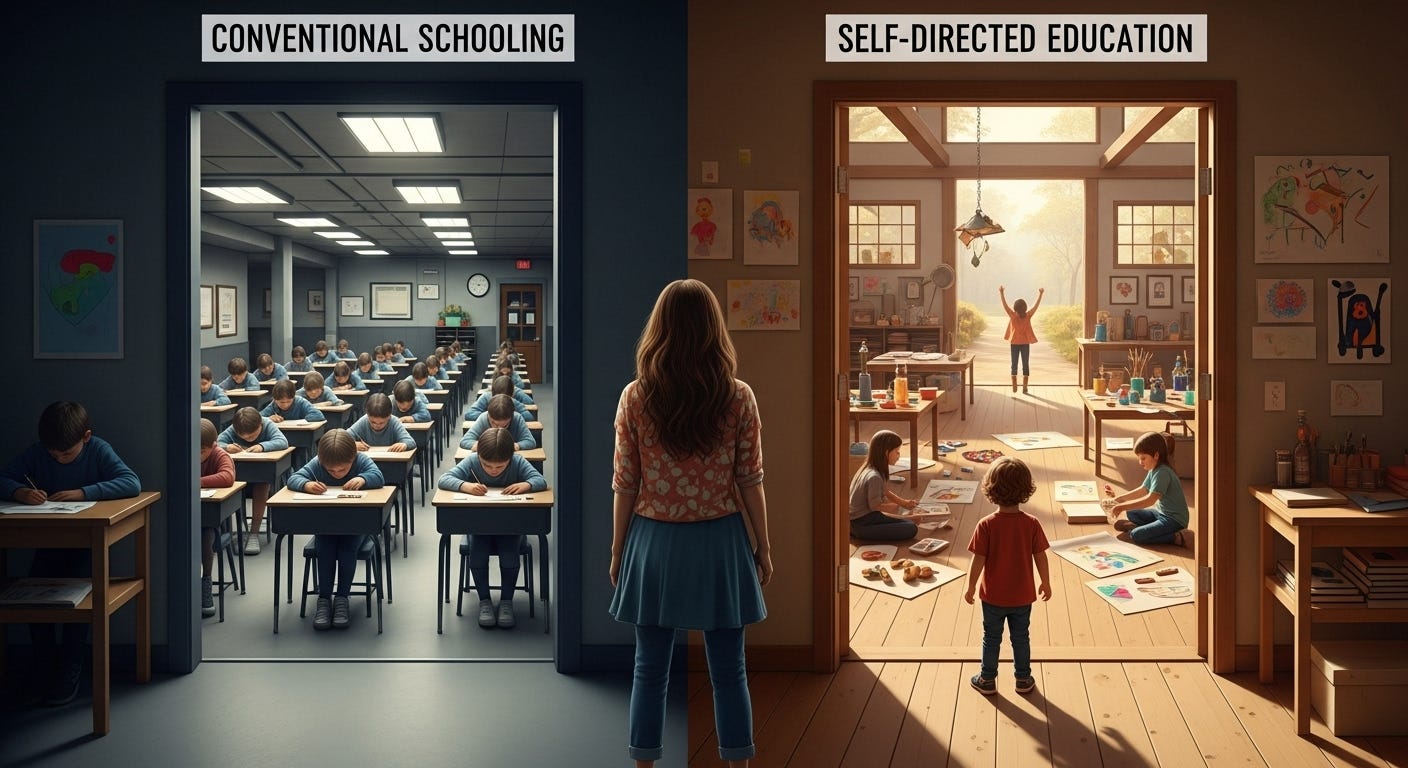
We tell ourselves that conventional schools are failing. That if we could just fix the funding, reduce class sizes, or update the curriculum, children would finally thrive. Parents advocate for change. Teachers work themselves to exhaustion trying to do better. Everyone agrees the system needs fixing.
Here is the uncomfortable truth: the system is not broken. It is working exactly as designed.
This realization stopped me cold when I first encountered it. For years, I taught in conventional schools, watching bright children dim under the weight of constant evaluation. I watched creative thinkers learn to hide their ideas. I watched confident learners become anxious performers. I told myself we just needed better methods, more resources, clearer standards.
I was wrong. The system was succeeding at its actual purpose all along.
Stated Purpose Versus Actual Outcomes: What the System Really Does
In the 1970s, Stafford Beer, the father of management cybernetics, coined a principle that reveals the truth about every system: POSIWID. The Purpose Of a System Is What It Does.
This principle cuts through all the mission statements, stated goals, and good intentions. POSIWID says we judge systems by their actual outcomes, not their claimed purposes. Whatever a system consistently produces is what that system is designed to produce.
Apply this lens to conventional schooling. Schools claim they develop critical thinkers, foster love of learning, and help children reach their potential. These are the stated purposes printed in every district mission statement and school handbook.
Now look at what conventional schooling actually produces. Not what it says it produces, what it actually creates year after year.
It produces adults who seek external validation before trusting their own judgment. It produces people who fear mistakes so deeply they avoid trying new things. It produces individuals who tie their worth to achievement and performance. It produces compliant workers who wait for instructions rather than taking initiative. It produces people-pleasers who struggle to set boundaries. It produces perfectionists paralyzed by the gap between their work and some impossible standard.
Research confirms these patterns. Peter Gray, research professor at Boston College, documents that 83% of teens list school as their primary source of anxiety. Teen suicides drop during school vacations. Alfie Kohn’s decades of research show that external rewards and punishments destroy intrinsic motivation. Michael Reichert, who studied over 1,500 boys across six countries, found that school systematically damages boys’ sense of self through practices that treat normal male development as a disorder requiring correction or medication.
The data is overwhelming. The patterns are consistent. The outcomes are predictable.
According to POSIWID, these outcomes are not unfortunate side effects. They are the purpose.
Why the System Doesn’t Change: Success Looks Like Compliance
Once you understand POSIWID, you understand why conventional schools resist change despite decades of reform efforts. The system does not need to change because it is achieving its goals.
Conventional schooling emerged during the industrial revolution to prepare workers for factory jobs. Those jobs required people who showed up on time, followed instructions without question, tolerated boredom and repetition, and accepted their place in a hierarchy. The system needed to produce compliant, manageable citizens who would not challenge authority or think too independently.
That system worked. It produced exactly what it was designed to produce.
The factory jobs largely disappeared. The industrial economy transformed. Society changed dramatically. The system did not change because changing the system would mean changing its purpose. Those in power benefit from citizens who doubt themselves, seek approval from authorities, fear failure, and stay in their assigned roles.
“The system produces what it was designed to produce. Compliance, not confidence. Obedience, not autonomy. When you understand this, you stop trying to fix yourself and start questioning the system that shaped you.”
Schools still operate on bells dividing the day into arbitrary segments. Students still need permission to use the bathroom or speak. Teachers still control what, when, and how children learn. Grades still reduce complex human development to single letters that determine worth and future opportunities. Tests still measure compliance with predetermined answers rather than genuine thinking.
The system succeeds at teaching children that adults know better than they do about their own needs, interests, and abilities. It succeeds at teaching them that mistakes mean failure rather than learning. It succeeds at teaching them that their value depends on performance. It succeeds at teaching them to compete with peers rather than collaborate with community.
These are features, not bugs.
Deschooling Yourself Means Rejecting the System’s Actual Purpose
Understanding POSIWID transforms how we approach deschooling. Deschooling is not about fixing what is broken in you. It is about recognizing that the system worked on you exactly as intended.
Your perfectionism is not a character flaw. It is evidence that school successfully taught you that your worth depends on flawless performance. Your people-pleasing is not weakness. It is proof that school successfully taught you that approval from authority matters more than your own needs. Your fear of failure is not inadequacy. It is confirmation that school successfully taught you that mistakes mean you are not good enough.
The system designed these outcomes. You internalized them because you were a child in a coercive environment during the years your brain was most plastic and your sense of self was forming.
Deschooling yourself means seeing these patterns for what they are: learned responses to a system optimized for compliance. These patterns made sense in a context where conformity was rewarded and autonomy was punished. They helped you survive an environment that did not support your authentic development.
Those patterns no longer serve you. Recognizing their origin is the first step toward transformation.
When you catch yourself seeking approval before trusting your judgment, pause. Notice it. Say to yourself: “The system taught me this. I can choose differently.” When you avoid trying something new because you might fail, recognize this as schooling still running in your nervous system. The fear is real, the threat is not. You are no longer in third grade. No teacher will shame you. No grade will define you.
This recognition creates space. In that space, you can begin building new patterns based on self-trust rather than external validation.
How Self-Directed Education Embodies a Different POSIWID
Self-Directed Education offers a fundamentally different purpose, revealed through its actual outcomes.
In Self-Directed Education, children control their learning. They choose what to learn, when to learn it, how to approach it, and whether to continue or move on. Adults act as resources and facilitators, not authorities who impose curriculum. There are no grades, no tests, no imposed schedules, no forced compliance.
What does this system actually produce?
Research on Self-Directed Education shows consistent outcomes. Young people develop strong intrinsic motivation because they pursue genuine interests rather than externally imposed requirements. They build self-trust because they make meaningful choices about their time and learning. They develop confidence because they solve real problems without adult interference or evaluation. They learn to assess their own work rather than depending on external judgment. They collaborate naturally because learning is not structured as competition. They take initiative because waiting for instructions is not part of the culture.
These children grow into adults who trust themselves. They know how to identify what they want to learn and figure out how to learn it. They handle failure as feedback rather than as proof of inadequacy. They set boundaries because they have practiced honoring their own needs. They think critically about systems because they have experienced an alternative to compliance-based institutions.
Self-Directed Education centers like Sudbury schools have decades of outcome data. Graduates attend college at rates similar to conventionally schooled students when they choose college. More importantly, they report satisfaction with their lives, confidence in their abilities, and comfort with self-direction. They describe their childhoods as joyful. They do not need years of therapy to recover from their education.
The purpose of Self-Directed Education, revealed through POSIWID, is human flourishing. When we judge it by what it actually produces, we see individuals who trust themselves, think independently, learn continuously, and enter adulthood as whole people who do not need to heal from childhood.
This is the new opportunity. This is not merely a reformed version of conventional schooling with slightly better methods. It is not merely the same system with nicer teachers or smaller classes. Self-Directed Education is a completely different system with a completely different purpose, proven by completely different outcomes.
Teaching Children to Question Systems, Not Just Memorize Content
One of the most powerful gifts you can give children is the gift of critical thinking. Give them the ability to look at any system and ask: what does this actually do? Not what does it claim to do. What does it produce?
This is systems thinking. This is real critical thinking. This is the education conventional schools claim to provide while actively preventing it.
When children learn to apply POSIWID, they develop immunity to manipulation. They can look at advertising and ask what it actually produces. They can look at social dynamics and recognize patterns. They can look at institutions and evaluate them by outcomes rather than stated intentions.
Schools do not want children thinking this way. A child who asks “what is the actual purpose of homework?” based on its real effects rather than its stated rationale is a threat to the system. A child who notices that grades produce anxiety and competition rather than learning is questioning the foundation. A child who recognizes that requiring permission to speak, move, or use the bathroom teaches helplessness rather than responsibility is seeing the system clearly.
Self-Directed Education creates space for this questioning. Children in these environments learn to evaluate systems by observing what they produce. They develop the critical thinking that conventional schools promise while actively suppressing it.
“When you teach children to judge systems by what they actually produce rather than what they claim to produce, you give them a lens for seeing truth. This is the education that transforms everything.”
You can begin this with your children now, regardless of where they attend school. When your child complains about a school rule, instead of defending it or dismissing their complaint, ask: “What do you think the rule actually does? Not what the teacher says it does, what does it produce?” Listen to their answer. They often see more clearly than adults who have learned not to question.
When your child brings home a graded paper, ask: “How did getting this grade make you feel? What did it make you think about yourself?” Help them notice the emotional impact of evaluation. Ask: “Did the grade help you learn? Or did it make you worry about the next grade?” Help them separate learning from performance.
These conversations plant seeds. They help children develop the capacity to see systems clearly. This capacity serves them for life.
Your Turn: Two Steps Toward Liberation Today
You do not need to wait to begin deschooling yourself. You do not need permission to start thinking differently about the patterns you carry.
Today, practice this: Notice when you judge yourself by performance metrics. When you catch yourself thinking you are not good enough because of productivity, appearance, or achievement, pause and say out loud: “The system taught me this. My worth is inherent.” This simple acknowledgment begins separating who you really are from what school taught you to believe. Do this every time you notice the pattern. The repetition matters.
This week, try this: Have a conversation with your child about the difference between stated purpose and actual outcomes. Use an example they can understand. “You know how your teacher says everyone should participate, but then only calls on kids who raise their hands quietly? What message does that actually send?” Help them develop systems thinking early. Ask them: “Based on what actually happens at school, what do you think the real purpose is?” Listen without correcting. Their observations are often more accurate than adults want to admit.
These small practices begin shifting your relationship with the patterns school created. They create space for new ways of thinking about yourself and your children.
Next week, we will explore how to recognize when you are still operating from school’s actual purpose even years after graduation, and the specific practices that help you choose differently.
The Clarity That Changes Everything
POSIWID forces us to look at what systems actually produce, not what they claim to produce. Conventional schooling does not fail to build confident, intrinsically motivated learners who trust themselves. It succeeds at producing the opposite because compliance, not autonomy, has always been its true purpose.
Deschooling yourself means recognizing that the shame, perfectionism, and self-doubt you carry are not personal failings. They are proof the system worked on you. The patterns you struggle with are evidence of successful conditioning, not evidence of your inadequacy.
Self-Directed Education offers a different POSIWID entirely. When we judge it by what it actually produces, we see young people who trust themselves, pursue genuine interests, think critically about systems, and enter adulthood without needing years of recovery from their education.
Understanding POSIWID is not about blame. It is about clarity. Once you see what the system is actually designed to do, you can stop trying to fix yourself and start building the alternative.
The system is working exactly as designed. The question is whether you will continue participating in a system designed to produce doubt, compliance, and dependency, or whether you will create the conditions for trust, autonomy, and growth.
For yourself. For the children you love. For the possibility of human flourishing that conventional schooling systematically prevents.
The choice has always been yours. Now you can see it more clearly.
If this article helped you see the system differently, please share it. Someone in your life is still trying to fix themselves instead of recognizing they were shaped by a system working exactly as designed.
Subscribe to get more articles on deschooling, healing from educational trauma, and creating the conditions where children and adults can thrive. Next week: How to recognize when you are still operating from school’s POSIWID even years after graduation, and what to do about it.
One More Thing
Are you a parent who is not sure if you should pull your kid out of school (or, you already have, and you’re not sure what to do next)? One of our subscribers asked, “Do you have a go to resource for parents considering making a change?” I want to create something genuinely helpful, but I need your input on what that should look like. This 7-question survey takes about 2 minutes: https://katypurviance.substack.com/survey/5798643
Awesome, congratulations on this masterpiece. I, too, started to appreciate the POSIWID approach, and have a draft substack post in the making (don't ask for how many months now 😅). I absolutely love your "deschool yourself" take on it. Really empowering!
re stacked .