

"I stay up at night wondering if keeping my kid in school is the decision I’ll regret most."
What parents call anxiety, school refusal, and a lost spark might be something simpler: your child telling you the truth.

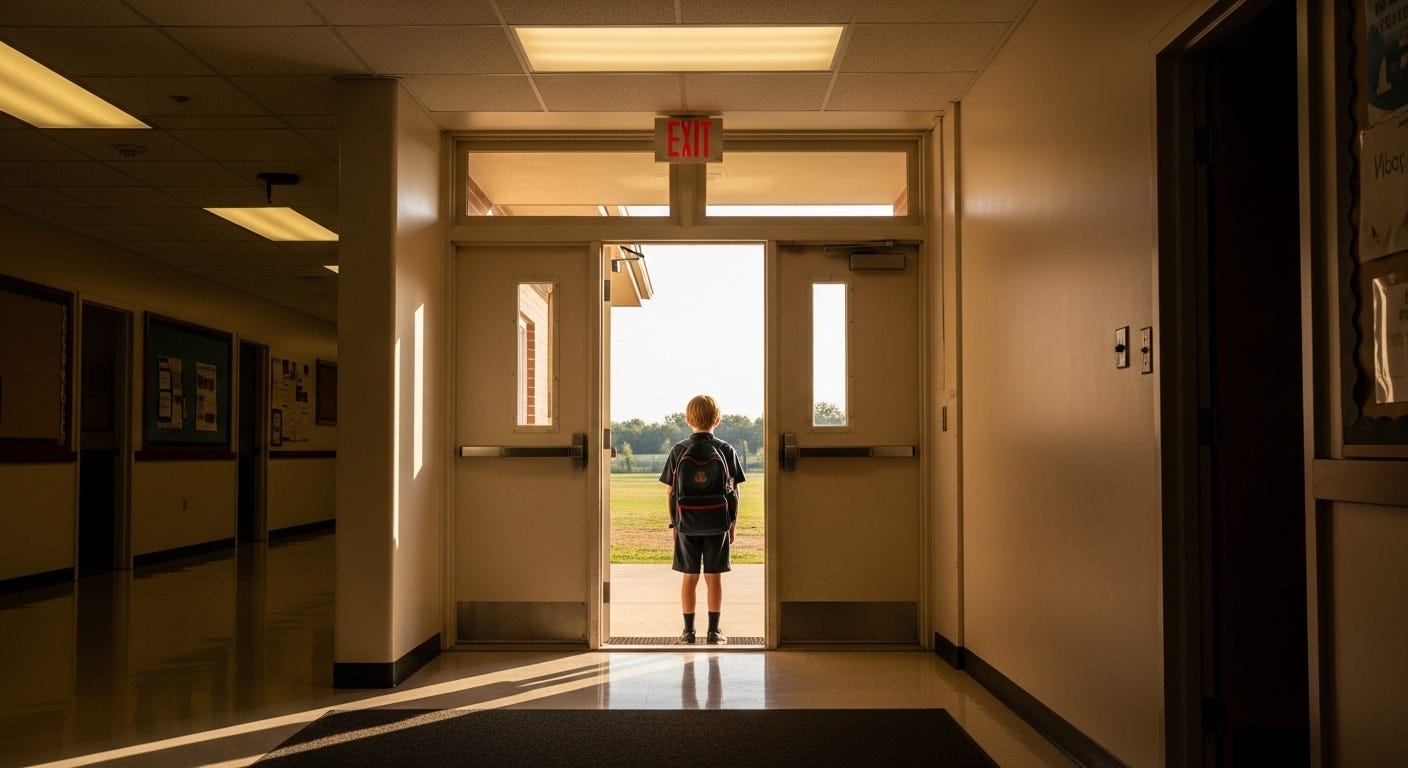
You’re lying in bed running the same loop you’ve run a hundred times before. The crying at drop-off on Monday. The email you sent the principal that got a three-sentence reply. The way your child came home last week and said, for the second time this month, “I hate myself.” You told yourself it was a phase. You advocated, supplemented, emailed, and explained away the warning signs for another semester. School starts again in nine hours, and you cannot shake the question: what if staying is the mistake I never forgive myself for?
You are not alone in this loop. You are not imagining it. Your child is not overreacting. The question you are afraid to ask out loud is the right question to finally ask.
When the light goes out
There is a specific kind of grief that parents keep describing. It is the grief of watching your child’s personality change. Season by season. School year by school year.
Parents describe the same before-and-after story with striking consistency. A child who was once curious, wild, and alive. A child who loved asking questions and woke up ready to know more about the world. Then school began, and their child turned into someone else.
“My otherwise outgoing and happy child started seeming despondent, depressed, and withdrawn,” one parent wrote on a parenting forum. “He’d often come home from school either in tears or close to tears. He said the words ‘I hate myself’ to me.”
The phrase that appears across parenting communities, Reddit, and comment sections is always the same: “the light went out.”
Parents describe the morning battle in physical terms. A child holding onto the car’s headrest with both hands, begging not to go. A child whose stomach ache begins at bedtime Sunday and peaks in the school parking lot Monday morning. A child with stress-induced hair loss. A 13-year-old who told a reporter, “I was literally pulling out chunks of my hair.” What parents mistake for “behavior problems” are their children’s bodies responding honestly to something that does not feel safe.
The grief is real because the loss is real. A parent is mourning a version of their child that school seems to have taken away from them.
Everything you’ve already tried
You did not do nothing. That is the part this conversation rarely acknowledges. You went to the meetings. You filed the paperwork. You supplemented at home, hired the tutor, navigated the IEP process, sent the emails, switched schools, gave the new school time to work. You have been in fight mode for so long that you cannot remember what it felt like not to be.
Parents who describe this stage reach, without realizing it, for combat language: “battle,” “advocate,” “fight mode,” “walking into the arena.” Researchers have found that mothers of children navigating special education systems carry stress hormone levels comparable to those of combat soldiers.
You switched schools and had a honeymoon period. Then the same patterns came back. You were labeled “the difficult parent” when you pushed harder. You were told to “trust the process,” “give it time,” and “try a different approach at home.”
At some point, a painful and clarifying thought arrived: you were already doing all of the work. The supplementing, the advocating, the late nights, the research. The school was the factor in the equation that was contributing the least to a solution. It was the thing you were constantly working around.
The hardest thing to see
Here is the part most people do not say plainly: for many children, school is the source of the harm, rather than a place where harm is being managed.
Peter Gray, research professor at Boston College and author of Free to Learn, has spent decades documenting what compulsory schooling does to children’s psychological wellbeing. When surveyed, 83 percent of teenagers name school as their primary source of anxiety. Teen suicide rates drop measurably during school vacations and declined further when schools closed during the COVID-19 pandemic. Research on student engagement shows that 74 percent of fifth graders feel genuinely engaged in school. By eleventh grade, that number has fallen to 32 percent. A Brookings survey of 65,000 students found that only 26 percent of tenth graders report loving school, while 65 percent of their parents believe they do.
Gray identified seven compounding harms of compulsory schooling: denial of liberty, interference with personal responsibility, the systematic undermining of intrinsic motivation, the fostering of shame through constant judgment, the promotion of bullying through artificial social hierarchies, the steady increase of anxiety and depression, and the destruction of natural curiosity.
None of that is your child’s fault. The teachers who care most are often suffering under the same structure, trapped between their instinct to nurture individual children and a system that was never built for that. The system produces these outcomes reliably, across schools and districts and decades. Your child is the data, not the outlier.
What your child needs, and what research says is possible
Every child enters the world as a natural learner. Before any school ever touches them, children acquire thousands of words, master complex grammar, and construct working theories about gravity and kindness and cause-and-effect, entirely through curiosity and play and the intrinsic drive to understand. Gray’s research on hunter-gatherer societies reveals that for hundreds of thousands of years before compulsory schooling existed, children educated themselves through play and exploration. When anthropologists asked adults in these communities how children learn, the answer was always the same: they teach themselves through observation, play, and exploration.
That drive does not disappear when a child enters school. It goes underground, covered over by bells, grades, and the daily message that what a child wants to know matters less than what has been scheduled for them to learn today.
When parents make the decision they were afraid to make, they say the same thing: “I feel like I have my children back. I don’t know that I had realized, fully, how I had lost them.” “The stomach pains are gone. They want to learn.” “My only regret was that I wish I had done it sooner.”
“It wasn’t until I got rid of the ‘school’ mentality that our lives blossomed and I watched my children love learning.”
Self-Directed Education, the philosophy practiced in democratic schools, sociocratic schools, and at centers like the Spokane Learning Co-op in Washington State, is built entirely around this understanding. Curiosity is the engine. The child’s own questions are the curriculum. Adults serve as guides rather than enforcers of a predetermined agenda.
Many parents keep sending their children to school because of a misunderstanding on their child’s ability to go to college without it. These parents should know that Peter Gray’s research on graduates of self-directed learning environments found that they had no difficulty gaining college admission, pursued the full range of careers, and showed particularly high representation in work requiring creativity, self-direction, and genuine initiative. More than a third chose their careers specifically for the pleasure of serving others.
Self-Directed Education is a well-documented alternative to a system producing measurable harm, and it is available to your family today.
Summary
The research is clear and the parent voices are consistent across thousands of communities. Children who show signs of school refusal, anxiety, physical distress, or a lost love of learning are responding to a system that was not designed for them. Peter Gray’s research documents what most parents sense but cannot name: school has become the single largest source of children’s psychological distress, and the children who thrive are the ones given genuine autonomy over their own learning.
Parents who are lying awake wondering whether staying in school see what school is doing to their children. Every parent who describes the other side of that decision says the same thing: “I only wish we had done it sooner.”
Self-Directed Education offers a fundamentally different relationship between children and learning, one grounded in trust, curiosity, and the understanding that children already know how to learn. You do not have to have everything figured out to begin. You only have to take your next right step.
Take the Poll
Subscribe for More
If this article landed somewhere real for you, there is more where it came from. The Joy of Learning exists for parents who are asking the questions no one around them seems to be asking yet. Subscribe below to keep reading. You are in the right place.
Share This Article
If you know a parent who is lying awake with this question, please send this to them. The research shows that parents in this stage are not looking for more information. They are looking for permission and validation. This article is both.
Join the Conversation
What are you sitting with right now? What question do you need answered before you can take your next step? Tell me in the comments. This community is full of parents who have been exactly where you are.
Help Me Help You
I am building a resource specifically for parents who are wrestling with this decision, and I need your input to make it as useful as possible. Would you take two minutes to complete my “Should I Pull My Kids From School?” survey? Your answers will directly shape what I create for you. Every response matters.
Citations
Gray, P. (2013). Free to Learn: Why Unleashing the Instinct to Play Will Make Our Children Happier, More Self-Reliant, and Better Students for Life. Basic Books.
Gray, P. (2011). The decline of play and the rise of psychopathology in children and adolescents. American Journal of Play, 3(4), 443-463.
Deci, E. L., Koestner, R., and Ryan, R. M. (1999). A meta-analytic review of experiments examining the effects of extrinsic rewards on intrinsic motivation. Psychological Bulletin, 125(6), 627-668.
Gallup. (2023). Engaged today, ready for tomorrow: Gallup student poll results. Gallup, Inc.
Gray, P. (2017). Self-directed education: Unschooling and democratic schooling. Oxford Research Encyclopedia of Education.
Parent testimonies sourced from r/Parenting, r/homeschool, r/ADHD, GreatSchools.org, Niche.com, Mumsnet, and Well-Trained Mind forums
This topic breaks my heart like almost nothing else. None of my three kids ever had the resistance to school that you describe, but I definitely saw - am still seeing - a slow extinguishing of the love of learning in my two younger ones. My oldest got to go to a great, innovative lab school, but it was private and very expensive. Here in Canada there is as far as I know no school such as you describe that is public. I honestly feel every day of my life that I’ve failed my kids because every day they go to this institution that seems designed to grind them down, kill their spirit, teach them to conform and shut down all their enthusiasm and curiosity.
In the states we have an option for online public school which was a life saver for my kids once they got to middle school and the physical environment got to be too overwhelming. It’s called K12.