

Five Ways to Build the Classroom You Dreamed Of: Curious Students, Joyful Learning, Real Community
Five changes that restore your integrity as an educator and give students the learning environment they desperately need

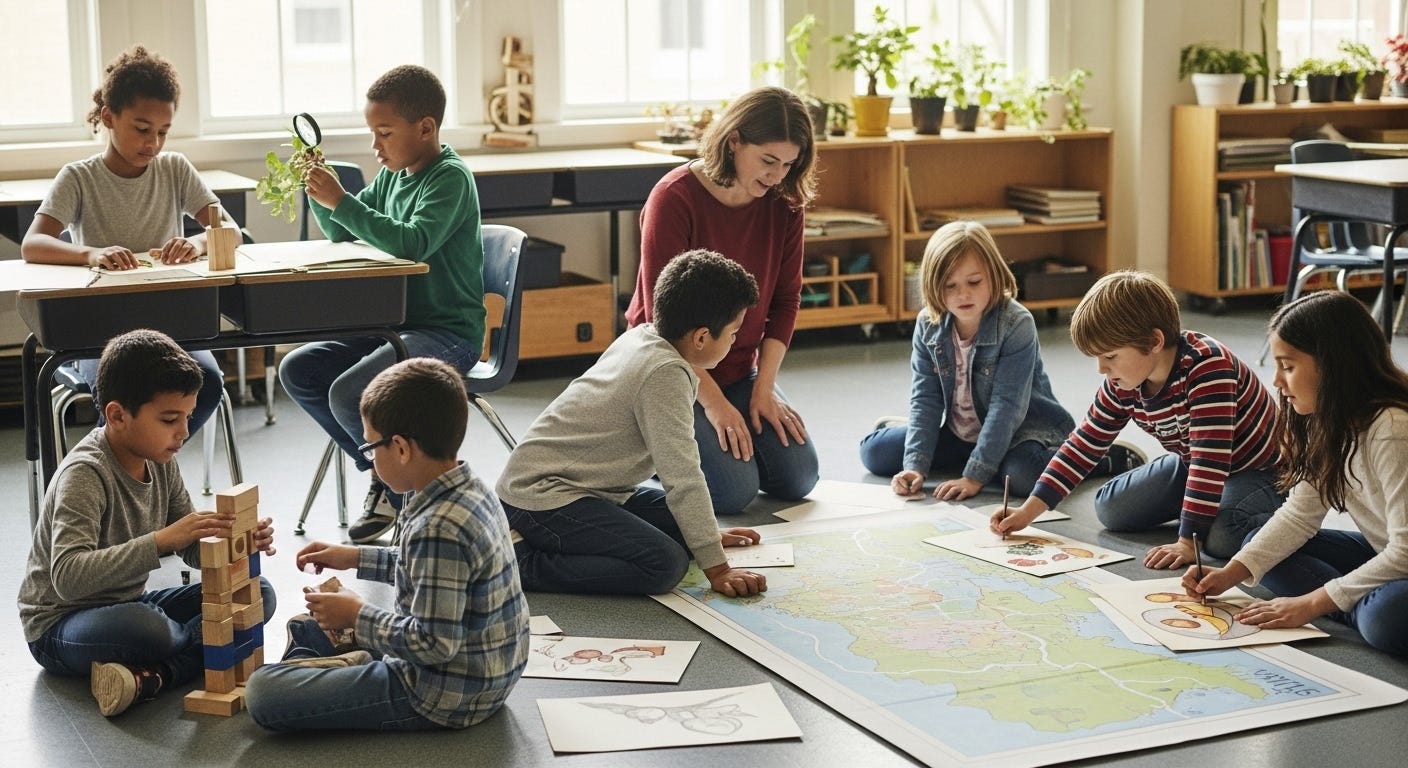
You became a teacher to help children discover their brilliance. Instead, you spend your days enforcing rules you don’t believe in, watching kids learn to hate learning while you’re powerless to stop it. You lie awake thinking about the boy you sent to the office for moving too much, the girl whose eyes went dead when you handed back that graded test, the student who stopped raising her hand after you corrected her in front of the class.
You’re exhausted from the performance of “good teaching” when good teaching apparently just means getting kids to comply quietly.
This isn’t burnout. Education philosopher Doris Santoro calls it demoralization: you’re not out of energy, you’re prevented from teaching the way you know is right. In her research with teachers, Santoro found that those experiencing the deepest distress were “most frustrated because they could not teach the way they believed was right.” One Teacher of the Year recipient she studied felt like a fraud, ashamed of “the dumbing down of her instruction to meet curriculum mandates.” Her assessment: “The people who were really damaged were the people who were already invested and caring and dedicated.”
If you recognize yourself in that description, you’re not alone. According to Gallup, K-12 teachers are the most burnt-out profession in America. Sixty percent of educators report being burned out, and over half say they will leave teaching sooner than originally planned.
What if you could change that starting tomorrow? What if Self-Directed Education principles could transform your classroom into the place you imagined in your teacher training program: a real community with mutual respect, creativity, intrinsic motivation, and celebration of learning?
You don’t have to leave the profession. You have to reclaim it.
Why Smart Teachers Feel Like Frauds: Understanding Moral Injury in Education
The weight you carry has a name. Santoro distinguishes between burnout and demoralization in a way that matters: “Burnout suggests that a teacher has nothing more to give. However, teachers whom I would characterize as demoralized were most frustrated because they could not teach the way they believed was right.”
You still have so much to give. The system just won’t let you give it.
Nearly 80% of educators report feeling moderate or large pressure to have students perform well on standardized tests. Yet UC Davis researcher Megan Welsh found that teachers who prioritized test prep saw no better results than those who taught more broadly. She observed: “I don’t think many teachers believe that intensive test prep is good instruction, but there’s a tension there because they feel they have to do it.”
Research shows that when teachers question policies, they are portrayed as “against student learning.” Asking critical questions gets treated as being morally wrong. As one teacher described: “It is a crazy-making environment for teachers who are using our intelligent minds to think critically and who care deeply about the integrity of our work.”
You entered teaching with a vision: Children gathered around you, eyes bright with curiosity, asking questions that mattered to them, pursuing understanding with genuine engagement. You imagined yourself as a guide, a facilitator of discovery, someone who helped young people develop confidence and competence.
The reality turned out to be something else entirely. You enforce compliance. You reduce complex human beings to numbers on tests. You watch natural curiosity dim under the weight of worksheets and arbitrary deadlines. You see children learning that their worth equals their performance, that mistakes mean failure, that the safest strategy is to stop taking risks.
This gap between who you wanted to be and who the system requires you to be creates moral injury. The damage isn’t to your capacity. It’s to your integrity.
“The people who were really damaged were the people who were already invested and caring and dedicated.” – Teacher of the Year recipient, quoted in Doris Santoro’s research on teacher demoralization
The Five Transformations That Change Everything
What if the problem isn’t you? What if the problem is that conventional schooling operates on principles that contradict everything we know about how humans actually learn?
Research professor Peter Gray at Boston College has spent decades studying how children educate themselves when given the freedom to do so. He identifies five biological educative drives that all humans possess: curiosity (exploring the broader world), playfulness (practicing skills creatively), sociability (learning from and with others), willfulness (taking charge of your own life), and planfulness (thinking ahead and making plans).
Conventional schooling, Gray argues, necessarily suppresses these drives to function. You cannot have 30 children all following their own curiosity simultaneously in a classroom designed for standardized outcomes. The structure demands compliance.
Self-Directed Education operates from a fundamentally different premise: children are biologically designed to educate themselves. When you stop suppressing their natural learning drives and start supporting them instead, transformation happens.
Here are five specific changes you can implement in your classroom, starting tomorrow, that align with how humans actually learn. These aren’t additions to your workload. They’re subtractions of the compliance enforcement that exhausts you.
Transformation 1: Replace Grades With Growth Conversations
Students enter your classroom carrying years of conditioning that their worth equals their performance. Research tracking students through high school found that high grades in eighth grade most strongly predict perfectionism in ninth grade, particularly during the vulnerable transition to high school. Students internalize that grades define them. Each mistake confirms inadequacy.
Alfie Kohn has synthesized decades of research on grading and reached three robust conclusions. First, grades diminish interest in learning. Every study investigating the impact of grades on intrinsic motivation has found a negative effect. Second, grades create preference for the easiest possible tasks. When performance is graded, students avoid intellectual risks. They choose shorter books and familiar topics to minimize the chance of doing poorly. Third, grades reduce the quality of thinking. Students skim for “what they’ll need to know” and ask “Is this going to be on the test?” rather than “How can we be sure that’s true?”
One student captured this perfectly: “I remember the first time that a grading rubric was attached to a piece of my writing. Suddenly all the joy was taken away. I was writing for a grade. I was no longer exploring for me. I want to get that back. Will I ever get that back?”
You can give that back.
Start with one assignment this week. Instead of a grade, provide narrative feedback focused on specific learning and progress. Ask “What did you learn?” and “What was interesting?” Frame the assessment as an opportunity to demonstrate understanding rather than a measure of worth. Help students track their own progress over time rather than comparing to peers.
This directly addresses the research showing that grade-based self-worth is one of the most damaging aspects of conventional schooling. You’re not lowering standards. You’re raising them by shifting focus from performance to actual understanding.
Transformation 2: Build Genuine Choice Into Every Day
Self-Determination Theory, developed by Edward Deci and Richard Ryan, demonstrates that autonomy support dramatically increases intrinsic motivation. When students have meaningful choices within necessary constraints, both engagement and actual understanding increase.
You’re still required to cover specific content. You don’t have to require everyone to cover it the same way at the same time.
Offer choices in topics within required curriculum: “We need to study this historical period. Which aspect interests you most?” Allow multiple ways to demonstrate learning: project, presentation, written work, performance, something you haven’t even thought of yet. Let students work at their own pace on some assignments. Give students meaningful input on classroom procedures and rules. Explain the why behind requirements rather than demanding blind compliance.
This shifts students from what Gray calls “intellectual dependency” (waiting to be told what to think) to developing autonomous thinking. It also shifts you from warden to facilitator.
The difference is immediate and visible. Students who’ve been disengaged suddenly have opinions about their learning. Conversations shift from “what do I have to do” to “can I try this approach.” You’re no longer fighting resistance because you’re no longer creating it.
Transformation 3: Create a Mistake-Friendly Culture
Sir Ken Robinson observed: “We don’t grow into creativity, we grow out of it. Or rather, we get educated out of it.” The mechanism is fear of being wrong. Children enter school willing to take risks. They try things without certainty of success. Then they learn that mistakes equal failure, that errors bring correction or shame, that the safest strategy is to stop attempting anything difficult.
Carol Dweck’s research on growth mindset versus fixed mindset shows that how teachers respond to mistakes fundamentally shapes student learning. When mistakes are treated as valuable information rather than failures, children develop the intellectual courage necessary for deep understanding.
Starting tomorrow, explicitly celebrate mistakes as evidence of learning in progress. When a student makes an error, respond with genuine curiosity: “That’s interesting thinking. Talk me through how you got there.” Be your real human self: model making mistakes yourself and processing them productively. Never use public correction or shaming. Reframe “I don’t know” as “I don’t know yet. Let’s figure it out together.” Reward risk-taking and experimentation over playing it safe.
This counters the fear of being wrong that Ken Robinson identified as fatal to creativity and learning. Within days, you’ll notice students more willing to attempt difficult problems. The classroom anxiety level drops. Kids who’ve been silent start raising hands. You stop being the enforcer of right answers and become a guide for thinking.
Transformation 4: Eliminate Public Comparison and Competition
Mixed-age classrooms are rare in conventional schools, so children spend years comparing themselves exclusively to same-age peers. Every assignment gets ranked. Every test sorts winners from losers. Even when you avoid explicit competition, students absorb the hierarchy through social dynamics, teacher attention patterns, and visible academic groupings.
Public evaluation amplifies the damage. While explicit shaming practices like dunce caps have disappeared, modern equivalents persist: color-coded behavior charts where students publicly move clips from green to yellow to red, names on the board for misbehavior, public posting of grades and test scores, calling out incorrect answers in front of the class, making examples of struggling students, comparing performance by saying “Look at how well Sarah did. Why can’t you?”
Even positive practices like celebrating high achievers create the inverse message for everyone not celebrated: you’re not good enough.
You can change this. Provide all feedback privately. Never post grades or publicly recognize “top performers.” Eliminate practices like calling out who finished first. Focus on individual growth rather than comparative achievement. Create collaborative rather than competitive learning structures. Stop using phrases that compare students to each other.
This removes the constant comparison mechanism that teaches children their worth is relative to others’ performance. Students stop seeing classmates as threats to their own success. Collaboration becomes natural because it’s no longer penalized by a zero-sum ranking system.
Transformation 5: Support Intrinsic Motivation Over External Rewards
The foundational research on motivation is the overjustification effect, demonstrated by Lepper, Greene, and Nisbett in 1973. Children who enjoyed drawing were divided into three groups. Those promised a ribbon for drawing later showed significantly less interest in drawing during free time. Unexpected rewards and no rewards? Interest remained unchanged. The conclusion: “Once rewards are no longer offered, interest in the activity is lost. Prior intrinsic motivation does not return.”
A meta-analysis by Deci, Koestner, and Ryan found that tangible rewards have a substantial undermining effect on intrinsic motivation, and the effect was especially strong for school-aged children. As Ryan and Deci summarized: “Students taught with a more controlling approach not only lose initiative but learn less effectively, especially when learning requires conceptual, creative processing.”
Token economy systems, gold stars, behavior charts, class money, points for compliance: these systematically destroy the intrinsic motivation that makes real learning possible.
Remove them. Help students connect to why the learning matters to them personally. Acknowledge effort and strategy rather than just praising results. Provide autonomy support through meaningful choices and explained rationale. Create conditions where curiosity can drive learning rather than the pursuit of external validation.
This addresses the extensive research showing that external rewards systematically destroy intrinsic motivation. Students who’ve been working for gold stars or grades will initially resist. They’ll ask “What do I get for this?” Your answer: “The satisfaction of understanding something that matters to you.” It takes time. It’s worth it.
What Your Classroom Will Actually Look Like
These changes create observable differences. Students ask questions because they’re genuinely curious, not because you demanded participation. Kids take intellectual risks because mistakes are safe. Children work on different aspects of the same topic based on their interests. Collaboration happens naturally instead of through forced group work. Students know specifically what they’re learning and why it matters, not just “it’ll be on the test.”
The shift in your experience is equally dramatic. You spend less energy managing behavior because you’re not creating resistance through control. You have actual conversations about ideas instead of negotiations about compliance. You watch children light up when they discover something rather than watching them perform understanding they don’t have.
You remember why you became a teacher.
Navigating Administrator Pushback: What to Say When Questioned
Your principal notices changes. Different students are working on different things. The classroom sounds different. There are no behavior charts on the wall. Grade reports look unfamiliar.
Here’s what to say: “I’m implementing research-based practices that increase student engagement and deepen understanding. Self-Determination Theory shows that autonomy support improves both motivation and learning outcomes. I’m still meeting all required standards. Students are demonstrating mastery through multiple assessment methods. Would you like to see the data on student progress?”
If pressed on grades: “Research by Alfie Kohn and others demonstrates that grades undermine intrinsic motivation and reduce quality of thinking. I’m providing detailed narrative feedback that gives students and families much more useful information about actual learning. Students can still receive letter grades for transcripts, calculated from demonstrated mastery rather than averaged compliance.”
If questioned about different students doing different work: “Differentiation is considered best practice. I’m providing multiple pathways to the same learning objectives. Students demonstrate mastery in ways that align with their strengths while still meeting required standards.”
Parents may worry. They’ve been conditioned to see school-like structures as evidence of real education. Share research. Explain what you’re doing and why. Invite them to observe. Show them their child’s actual work and growth rather than relying on letter grades as shorthand for learning.
Some will resist. Most will be relieved to hear a teacher talking about their actual child rather than a percentile rank.
The Research That Proves This Works
You’re not experimenting on children. You’re implementing principles backed by decades of research on how humans learn.
Sudbury Valley School, where students control their own education without imposed curriculum, grades, or age segregation, has tracked graduates for over four decades. Between 83% and 90% of students who wanted to attend college did so, attending institutions ranging from Ivy League to state universities with no apparent difficulty with academics. Eighty percent reported being happy with current life. They cited advantages including self-motivation, personal responsibility, and democratic values.
Peter Gray’s survey of 75 grown unschoolers found that 83% pursued higher education, 78% were financially self-sufficient, and 96% felt the advantages outweighed disadvantages. They showed lower rates of anxiety and depression compared to conventionally schooled peers.
Research on Montessori education, which emphasizes self-directed learning, hands-on materials, and no grades or external rewards, shows students average one school year ahead academically by sixth grade while showing superior executive function, social-emotional skills, creativity, and intrinsic motivation. Most importantly, Montessori students report more positive school experiences and stronger self-concept.
Self-Directed Education centers like Sudbury Valley School and sociocratic schools like the Spokane Learning Co-op in Washington State demonstrate what becomes possible when you trust children as natural learners.
The evidence is clear: children who experience autonomy support rather than control show higher academic achievement, better mental health, stronger intrinsic motivation, and positive self-concept.
You cannot replicate a full Self-Directed Education environment within conventional school constraints. You can move significantly in that direction. The benefits for both you and your students are immediate and profound.
Things You Can Try Starting Tomorrow
Today: The Mistake Celebration
Tomorrow morning, tell your students: “I’ve been thinking about mistakes. Every time I’ve learned something important in my life, it came from getting something wrong first. So starting today, we’re going to celebrate mistakes differently.”
Throughout the day, when a student makes an error, respond with genuine curiosity: “That’s interesting thinking. Talk me through how you got there.” When you make a mistake yourself, and make one deliberately if needed, narrate it: “I just realized I mixed up the dates. This is actually helpful because now I understand why that confused everyone.”
Research shows that mistakes followed by correction create stronger neural pathways than getting things right the first time. When mistakes are treated as valuable information rather than failures, children develop the intellectual courage necessary for deep learning.
Within days, you’ll notice students more willing to attempt difficult problems. The classroom anxiety level drops. Kids who’ve been silent start raising hands. You stop being the enforcer of right answers and become a guide for thinking. This single shift begins dismantling the performance anxiety that makes teaching exhausting and learning superficial.
This Week: Real Choices
Take one required unit this week and build choice into it. If you must cover the water cycle, let students choose their path: research it through real-world applications like agriculture or weather forecasting, create a physical model, write from the perspective of a water molecule, investigate local watershed issues, or compare water cycles on different planets. How about interpretive dance? My second graders have done it.
Provide the learning objectives and assessment criteria, then let students choose their approach. Create small groups based on chosen methods and let them work together.
Self-Determination Theory demonstrates that autonomy support, giving meaningful choices within necessary constraints, dramatically increases intrinsic motivation. This isn’t permissiveness. It’s recognizing that 30 people cannot all follow the same path to the same place at the same speed.
You’ll see students actually engaged with required content for the first time. Conversations shift from “what do I have to do” to “can I try this approach.” Kids collaborate because they’re genuinely interested, not because you mandated group work. Parents notice their children talking about school projects at dinner.
You remember why you became a teacher: to watch humans discover things that matter to them.
The Classroom You Can Create
Teachers experiencing moral injury are trapped between knowing what’s right and being forced to do what’s wrong. You can break that trap. These five principles don’t require permission from administrators or curriculum specialists. They require you to trust what research has proven: children are natural learners who thrive when we stop suppressing their biological drives and start supporting them instead.
Replace grades with growth conversations. Build genuine choice into every day. Create mistake-friendly culture. Eliminate public comparison and competition. Support intrinsic motivation over external rewards.
These aren’t additions to your workload. They’re subtractions of the compliance enforcement that exhausts you. They transform your classroom into the learning community you imagined when you first chose teaching.
You’ll face questions from administrators and concerns from parents. The research provides answers. Your students’ engagement provides proof. Your own renewed sense of professional integrity provides sustainability.
The transformation begins with single practices implemented tomorrow, expands through the week, and ultimately creates the classroom where children trust themselves, take risks, collaborate, and celebrate discovery.
You don’t have to leave the profession to reclaim your integrity as an educator. You have to start teaching the way you always knew was right.
What will you transform first?
Which Self-Directed Education principle resonates most strongly with your experience?
Share this with a teacher who needs hope
You know a colleague who’s questioning whether to stay in the profession. They need to know there’s another way to teach that doesn’t require breaking their integrity or breaking children. Share this article with them.
Get weekly strategies for transformation
Subscribe to receive practical approaches for bringing Self-Directed Education principles into conventional classrooms. Teachers transforming education from the inside need community and support. You’re not alone in this work.
Join the conversation
What would change in your classroom if you adopted some of the strategies described in this article? What’s your biggest fear about trying these approaches? Other teachers implementing SDE principles want to hear your questions and experiences. Comment below.
References
Deci, E. L., Koestner, R., & Ryan, R. M. (1999). A meta-analytic review of experiments examining the effects of extrinsic rewards on intrinsic motivation. Psychological Bulletin, 125(6), 627-668.
Dweck, C. S. (2006). Mindset: The new psychology of success. Random House.
Gray, P. (2013). Free to learn: Why unleashing the instinct to play will make our children happier, more self-reliant, and better students for life. Basic Books.
Gray, P., & Chanoff, D. (1986). Democratic schooling: What happens to young people who have charge of their own education? American Journal of Education, 94(2), 182-213.
Kohn, A. (2011). The case against grades. Educational Leadership, 69(3), 28-33.
Lepper, M. R., Greene, D., & Nisbett, R. E. (1973). Undermining children’s intrinsic interest with extrinsic reward: A test of the “overjustification” hypothesis. Journal of Personality and Social Psychology, 28(1), 129-137.
Robinson, K. (2006). Do schools kill creativity? TED Talk.
Ryan, R. M., & Deci, E. L. (2000). Self-determination theory and the facilitation of intrinsic motivation, social development, and well-being. American Psychologist, 55(1), 68-78.
Santoro, D. A. (2018). Demoralized: Why teachers leave the profession they love and how they can stay. Harvard Education Press.
Katy, I love all of this! I have 4 kids, now aged 21-26, who all have nontraditional learning journeys. We found our way to unschooling and it was hands down the best thing I could have wished for our kids.
I so much appreciate your adaptation of the principles for the school classroom. It can be done!